Vermont flood sightings
The Colour Out of SpaceThe Vermont flood sightings are reports of strange, apparently nonhuman forms found in rivers after the historic floods of November 3, 1927. They matter not because the accounts immediately prove what the witnesses saw, but because their striking consistency brings half-forgotten local legends into public debate and sets Albert N. Wilmarth on the path from folkloric explanation to direct investigation.
Background and Sources
Wilmarth first encountered the reports as an instructor of literature at Miskatonic University in Arkham and an amateur student of New England folklore. In the press coverage of flood hardship, suffering, and relief, scattered accounts described uncanny things carried along in swollen rivers. Friends asked him to interpret them; he initially took the stories for rustic superstition and was amused that educated acquaintances thought some obscured fact might lie beneath them.
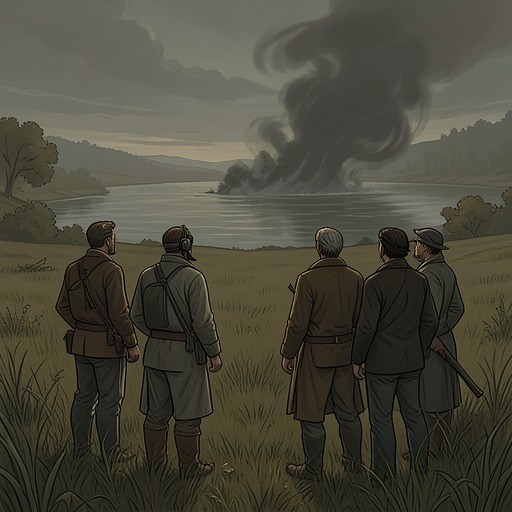
Most accounts reached him through newspaper clippings. One came by a different route: a friend received a letter from his mother in Hardwick, Vermont, who repeated a local story. After comparing the reports, Wilmarth concluded that they resolved into three principal instances: one near Montpelier on the Winooski River, one on the West River in Windham County beyond Newfane, and one on the Passumpsic River in Caledonia County above Lyndonville. Other stray reports, he thought, collapsed into these three clusters. In each, country people said they had seen one or more bizarre objects in waters surging down from the seldom-visited hills.
What Witnesses Reported
The accounts described pinkish forms about five feet long, with crustacean bodies, large dorsal fins or membranous wings, several sets of jointed limbs, and a convoluted, antenna-covered ellipsoid in place of a familiar head. Witnesses distinguished them from human bodies swept along in the disaster: despite a superficial resemblance in size and outline, they were said not to be human, nor any animal known in Vermont. The reports’ agreement on unusual anatomy gave Wilmarth pause, even though he believed folklore could account for that agreement.
The flood stories also echoed a much older body of hill-country lore. In Eli Davenport’s rare monograph, based on material collected orally before 1839, Wilmarth had read of a hidden race dwelling in remote woods, high peaks, and dark stream-cut valleys. Accounts cited clawlike prints in mud, stone circles that seemed not wholly natural, and caves partly blocked by boulders. The beings were seldom seen, but the descriptions converged on huge, light-red, many-legged crabs with batlike wings. Some stories even pictured them walking in formation or launching into the night sky. The resemblance between these legendary figures and the forms reported in the floodwaters made the new stories culturally legible, without establishing that the witnesses had actually encountered such beings.
Legend, Custom, and Competing Interpretations
The lore was not a single stable explanation. Puritan settlers had treated the beings as the devil’s familiars; some settlers of Celtic heritage associated them with malign fairies or little people. Indigenous traditions differed, but Pennacook myths described Winged Ones from the Great Bear who maintained earthly outposts, mined stone, and returned to the stars. These stories warned against approaching their territory or listening to their buzzing, humanlike voices. Across versions, the creatures tended to harm people who trespassed or spied on them, while animals were said to shun them instinctively.
Older accounts also suggested a changing relationship with human communities. Later layers of legend told of clawprints by farmhouse windows, disappearances beyond the most notorious areas, buzzing voices that made offers to lone travelers, and remote people believed to have undergone a disturbing mental change. Wilmarth’s account thus places the flood sightings against traditions that had already linked the hill beings with isolation, intrusion, and unexplained disappearances.
Those traditions had largely faded during the nineteenth century. As settlements and habitual routes became established, people continued to avoid some hills as unhealthy, unprofitable, or unlucky, but often no longer remembered the fears that had shaped those patterns. The remote places were left alone as much through custom and economic habit as through deliberate caution. By the time of the flood, only occasional local scares and the stories of older people kept the beings in circulation.
Wilmarth’s Skepticism and the Public Dispute
Wilmarth’s first explanation was that simple backwoods witnesses had mistaken bloated human beings or farm animals in turbulent water for monsters, with inherited stories supplying the extraordinary details. He regarded the recurring folklore as a familiar form of imaginative natural personification, comparable to old European accounts of hidden races and spirits. Similarity between legends, in his view, did not make them factual.
His opponents drew the opposite lesson from the consistency of both the older tales and the recent reports. They argued that largely unexplored Vermont hills made confident denial premature, and that the accounts were too coherent and prosaically told to dismiss outright. A few invoked Charles Fort and the possibility of visitors from other worlds; others proposed that an ancient nonhuman race might have survived in hiding. Wilmarth answered these claims by comparing the legends with traditions from elsewhere, including reports of the Mi-Go in Himalayan lore, but the comparisons did not settle the argument. His skeptical reading remained the same: recurring motifs could reflect recurrent human imagination rather than a real hidden population.
Aftermath and Narrative Significance
The dispute moved from conversation into letters published in the Arkham Advertiser. The Rutland Herald printed extracts from both sides, while the Brattleboro Reformer reprinted one of Wilmarth’s long historical and mythological arguments alongside approving commentary. By spring 1928, he had become nearly a public figure in Vermont despite never having visited the state. The flood stories had therefore acquired a second life: they were no longer merely reports from the riverbanks but evidence argued over in print.
That debate brought Wilmarth into contact with Henry Akeley, whose letters would lead him to reconsider how much weight he gave the accounts. Akeley’s later evidence included photographs of a clawlike print and a recording made near a cave on the wooded west slope of Dark Mountain, where a buzzing voice spoke human words. These were not the flood sightings themselves, and they did not retrospectively turn every report into verified fact; they did, however, connect the flood stories to a broader investigation of the same legendary beings. In the wider narrative, the sightings function as the first public disturbance in Wilmarth’s settled skepticism: a pattern of descriptions he had explained away becomes the opening through which increasingly tangible, and increasingly difficult to interpret, evidence enters.